






It’s 2025, and global digital ad spend has surged past $700 billion. But here’s the kicker: brands aren’t just throwing money at visibility anymore—they’re demanding results.
Imagine this: you’re pouring thousands into flashy ads, crossing your fingers they’ll move the needle. Now contrast that with a smarter approach—one where you only pay when someone actually clicks, signs up, or buys. That’s not a marketing gamble; that’s a performance play.
Welcome to the world of performance marketing.
At its core, performance marketing flips the traditional model on its head. Instead of vague goals like “increase brand awareness,” it’s all about clear, trackable outcomes—clicks, leads, conversions. You know exactly what you’re paying for, and more importantly, what you’re getting back.
So, what is performance marketing? And why is it the buzzword echoing through digital boardrooms, agency meetings, and marketing podcasts alike?
What is Social Media in Digital Marketing?
Because in a world where every dollar counts, paying for performance—not potential—is the new gold standard.
Definition Decoded: What is Performance Marketing, Really?
So, what is performance marketing? Simply put, it’s a results-first digital marketing strategy where businesses only pay when a specific, measurable action takes place. That could be a click, a form submission, a newsletter sign-up, or the holy grail—a sale.
Think of it as digital marketing with a contract that says: “No results? No payment.”
Unlike traditional advertising, where spend often chases impressions or vague notions of reach, performance marketing is rooted in accountability. It operates on hard metrics, data-driven tracking, and real-time feedback loops, making it a favorite for ROI-focused brands and growth-hungry startups.
Here’s how it works in everyday language:
You’re not paying a billboard company to hope drivers remember your website. You’re paying a publisher, affiliate, or ad network only when someone lands on your site and does what you want them to do—whether that’s signing up, buying, or clicking through.
And it’s not just about who sees your ad—it’s about who acts.
In the wider world of digital marketing strategy, performance marketing shines as a laser-focused approach. It zeroes in on outcomes, not outputs. It marries online advertising, conversion tracking, and campaign optimization into one measurable, scalable machine.
And because it relies heavily on analytics, automation, and real-time performance data, it’s not just marketing—it’s smart marketing.
5 Key Ways on How Performance Marketing Works
Now that we’ve nailed down what performance marketing is, let’s open the hood and see how it actually runs. Spoiler: it’s not magic—it’s method.
Here’s how performance marketing works, step by step:
1. Set Clear, Measurable Objectives
Every great performance marketing campaign starts with a sharp target. Not “we want more exposure,” but something like “increase qualified leads by 30% this quarter” or “reduce cost per acquisition (CPA) by 15%.” These aren’t wishes—they’re KPIs.
Whether it’s lead generation, e-commerce sales, or app installs, defining the what is the foundation for tracking the how.
2. Pick Your Platforms Strategically
Performance marketing lives across a wide digital ecosystem. Think:
- Paid search marketing (Google Ads, Bing)
- Social media advertising (Meta, LinkedIn, TikTok)
- Affiliate marketing networks
- Native ads and display advertising
Each channel has its strengths, and part of performance marketing’s power lies in choosing the right mix for your goals.
3. Launch Campaigns with Tracking in Place
Now comes the techy—but critical—part. To ensure every click, signup, and sale is accounted for, marketers deploy tracking tools like:
- UTM parameters
- Conversion pixels
- Campaign codes
- Performance marketing platforms (e.g., Impact, Partnerize)
This is where conversion tracking, real-time analytics, and ROI measurement step in. You know exactly what’s working—down to the ad, the platform, even the keyword.
4. Optimize, Tweak, Repeat
Performance marketing is built to learn and adapt. You’re constantly analyzing:
- Which creatives convert best?
- Which audiences deliver the lowest CPA?
- Where’s the drop-off in the funnel?
With data at your fingertips, you can tweak your targeting, budget allocation, ad copy, and even landing pages in real time. This campaign optimization loop is what separates winners from wasters.
5. Pay Only When It Performs
And here’s the big payoff: you only pay for actual results. Whether it’s a click, lead, or sale, every dollar is tied to a completed action. No more paying for ads that no one engages with.
This pay-per-performance model makes it one of the most cost-efficient and low-risk strategies in the digital marketing toolkit.
In essence, performance marketing is like a smart vending machine—you only drop coins when it actually dispenses value.
Affiliate Marketing vs. Performance Marketing: What’s the Real Deal?
Here’s where things often get mixed up. People hear “performance marketing” and immediately think “affiliate marketing.” And while they’re closely related, they’re not interchangeable.
So, what’s the real difference?
Affiliate Marketing: A Subset of Performance Marketing
Affiliate marketing is a specific tactic under the performance marketing umbrella. In this model, third-party partners—known as affiliates—promote a product or service using their own channels. Think:
- Bloggers reviewing software
- YouTubers dropping referral links
- TikTok creators demoing products
- Email marketers recommending services
They only get paid when their efforts lead to a conversion—a sale, sign-up, or other desired action.
The draw? Affiliates are often experts at reaching niche audiences, creating authentic content that drives trust and action.
Performance Marketing: The Broader Powerhouse
While affiliate marketing is about leveraging external partners, performance marketing takes a more multi-channel, advertiser-controlled approach. It covers:
- Pay-per-click (PPC) advertising
- Paid social media campaigns
- Native ads and influencer partnerships
- Programmatic media buying
- And yes—affiliate marketing too
What ties it all together is the pay-for-performance model. Whether the traffic comes from a Facebook ad or an affiliate blog post, the principle remains: you only pay when you see results.
So, Why Does This Matter?
Because understanding the distinction helps you build smarter campaigns. If your brand wants to scale with influencers and niche content creators, affiliate marketing is a strong play. But if you also want to control messaging and rapidly test ads across digital platforms, performance marketing gives you the full toolkit.
In short:
Affiliate marketing is a tactic.
Performance marketing is a strategy.
5 Benefits of Performance Marketing You Can’t Ignore
Let’s be honest—marketers love numbers. But more than that, they love results. And performance marketing delivers exactly that: a data-rich, cost-efficient, ROI-obsessed machine that helps businesses grow smarter.

Here’s why the world’s savviest brands are leaning in:
1. Cost Efficiency Like You’ve Never Seen
In traditional advertising, you pay upfront—hoping for impressions, reach, or brand lift. In performance marketing? You pay only when a goal is met. Whether it’s a click, a download, or a sale, you’re buying outcomes, not airtime.
This model slashes wasted ad spend and ensures every dollar drives tangible impact.
2. Real-Time Data = Real-Time Decisions
With tools like Google Analytics, UTM parameters, and custom dashboards, performance marketers can track every move their audience makes. You’re not waiting until the campaign ends to see if it worked—you’re optimizing on the fly.
That means faster pivots, smarter budgets, and better results.
3. Hyper-Measurable ROI
Because every campaign is tied to specific actions—click-throughs, cost per acquisition (CPA), conversion rates—there’s no guesswork. You know what works. You know what doesn’t. And you can scale accordingly.
No vague “brand sentiment.” Just clean, trackable ROI.
4. Scalability That Grows With You
Whether you’re running ads in one city or launching a global product, performance marketing scales. As your campaign delivers results, you can increase spend confidently, knowing you’re investing in proven performance—not marketing fluff.
5. Unmatched Flexibility
Paid search? Social media advertising? Affiliate partnerships? You can mix and match tactics, test creatives, swap out channels—and adapt based on what drives conversions.
Performance marketing lets you build a dynamic digital marketing strategy that evolves with your audience.
At the heart of it all, performance marketing is about control and accountability. It gives brands the power to stop guessing and start growing—using data, insight, and precision targeting.
And now that we know the benefits, it’s time to explore the tools and platforms that make it all work.
6 Popular Channels Used in Performance Marketing
Performance marketing isn’t locked into one platform or tactic—it’s a multi-channel machine. Its beauty lies in versatility: the ability to test, track, and scale across a range of digital spaces where your audience already lives, scrolls, and clicks.
Here’s where performance marketing campaigns are making noise—and converting like crazy:
1. Paid Search (PPC Advertising)
Think Google Ads, Bing Ads, and beyond.
This is where intent meets opportunity. When someone searches “best running shoes for flat feet,” a well-timed ad can land a sale. You’re targeting users actively looking for solutions—and paying only when they click.
2. Social Media Advertising
Platforms like Facebook, Instagram, TikTok, LinkedIn, and even Pinterest now offer robust ad solutions built for performance.
With tools for granular audience targeting, retargeting, and lookalike modeling, social ads are a playground for:
- Lead generation
- Product sales
- Webinar sign-ups
- App installs
Best of all? Every tap, scroll, and swipe is trackable.
3. Affiliate Marketing Networks
We’ve touched on this already, but it’s worth repeating: affiliate marketing is a high-ROI performance tactic. It’s a powerful way to tap into trusted creators and publishers who already have access to your ideal audience.
You don’t need to chase traffic—they bring it to you. And they only earn when they deliver conversions.
4. Native Advertising
These are the “sponsored content” ads that blend seamlessly into articles, blog posts, or newsfeeds. When executed well, native ads feel organic and value-driven, increasing engagement and click-through rates.
Native platforms like Taboola, Outbrain, or Revcontent help you get your message in front of the right eyes—with performance-based pricing models.
5. Programmatic Display & Retargeting
Programmatic platforms use AI and automation to buy ad space in real-time, targeting users based on behavior, demographics, and interests.
Add in retargeting, and you’re re-engaging visitors who bounced—nudging them back into your funnel.
Smart. Automated. Effective.
6. Email Marketing with Performance Goals
Performance marketing doesn’t stop at ads. Many brands use email campaigns as part of their performance mix, especially when tracking metrics like:
- Open rates
- Click-through rates
- Purchases or sign-ups
And with marketing automation platforms, you can build email sequences that respond to user behavior, all while tracking the ROI of every send.
In essence, performance marketing isn’t about where you advertise—it’s about how and why. Each channel is chosen not for flash, but for function. If it converts, it scales. If it doesn’t? It’s optimized or dropped.
Challenges & Considerations: It’s Not All Smooth Sailing
For all its strengths, performance marketing isn’t some plug-and-play profit machine. Like any sharp tool, it can cut both ways if you’re not careful. Behind the impressive conversion rates and ROI dashboards lie a few realities marketers must face.
Here’s what to watch for:
1. Ad Fraud: The Silent Budget Killer
Clicks that aren’t real. Bots that fake conversions. Sketchy affiliates using shady tactics.
Ad fraud is a multi-billion-dollar problem, especially in high-volume campaigns. Without proper fraud detection and partner vetting, brands can waste serious budget on fake results that look good on paper but don’t drive revenue.
Pro tip: Use tools that verify traffic quality and regularly audit partner performance.
2. Attribution Headaches
You’ve got Facebook, Google, email, influencers, affiliates—all driving traffic. But who actually closed the sale?
Attribution models are tricky. Giving credit where it’s due (and not double-counting conversions) can get messy fast—especially in multi-touch journeys.
Performance marketing demands solid attribution models to measure the true impact of each channel and touchpoint.
3. Over-Optimization and Short-Term Thinking
Because performance marketing is so focused on immediate results, there’s a risk of neglecting long-term brand-building.
You might optimize your ad to death for a better CTR, but lose sight of the story your brand is telling. And audiences notice.
Smart marketers balance performance campaigns with branding efforts that nurture loyalty, not just conversions.
4. Platform Dependence
Putting all your performance spend into one platform (say, Meta or Google) can be risky. Algorithms change. Costs fluctuate. And suddenly, your top-performing channel tanks.
Diversification is key. Spread performance spend across multiple channels, so your growth isn’t tied to one data source—or one algorithm’s mood.
5. Data Overload
With real-time dashboards, CPA tracking, A/B testing, and automated reports flying in daily, it’s easy to drown in data.
More isn’t always better—unless you know which metrics matter most. Without a clear analytics strategy, you could waste time chasing vanity metrics instead of meaningful ones.
Performance marketing is powerful, yes. But it’s also demanding. It requires constant monitoring, a clear strategy, and the willingness to adapt fast.
The Future of Performance Marketing: Trends to Watch
Performance marketing has come a long way from banner ads and basic affiliate links. Today, it’s a data-powered ecosystem—and tomorrow? It’s going to be even smarter, faster, and more personalized.
Here’s what’s reshaping the performance marketing landscape in real time:
1. AI-Powered Optimization is the New Norm
Forget manual A/B testing—AI and machine learning are taking the guesswork out of campaign optimization. Platforms now analyze user behavior, predict outcomes, and automatically adjust:
- Bidding strategies
- Creative content
- Ad placements
This means higher conversions with less hands-on tweaking—marketers can scale campaigns while AI handles the micro-decisions.
2. Privacy, First-Party Data, and Cookieless Targeting
With the phase-out of third-party cookies and stricter data privacy laws (think GDPR and CCPA), marketers are shifting to first-party data strategies.
Expect a rise in:
- Email list-building
- CRM-powered targeting
- Contextual advertising
The future of performance marketing is ethical, permission-based, and privacy-conscious—but still laser-targeted.
3. Cross-Channel Attribution Gets Smarter
The customer journey is more fragmented than ever. Users bounce between apps, devices, and platforms before converting.
Emerging tools in cross-channel attribution and data stitching will help marketers understand the full path to purchase, not just the last click. That means smarter spend, better insights, and tighter strategy.
4. Creative + Data = Performance Gold
It’s not just about where or when you advertise—it’s how you connect. Brands are investing in creative that converts, built from performance data.
We’re seeing a new hybrid emerge: data-driven storytelling. The most successful ads won’t just sell—they’ll resonate. Think:
- Dynamic video ads tailored to user behavior
- Interactive social content backed by engagement data
- Personalized email funnels optimized for micro-conversions
5. Marketing Automation Takes the Wheel
From triggered email workflows to automated bidding and real-time personalization, automation is becoming the engine behind scalable performance campaigns.
Smart stacks using tools like HubSpot, ActiveCampaign, Klaviyo, and Meta’s Advantage+ mean brands can deliver relevant, real-time messages at scale—without lifting a finger after setup.
The bottom line?
Performance marketing is evolving from tactical hustle to strategic orchestration. The future belongs to brands that blend tech, creativity, data, and agility—turning every click, every view, every conversion into a measurable growth lever.
Global Digital & Performance Marketing in 2025
Overall Ad Spend & Growth
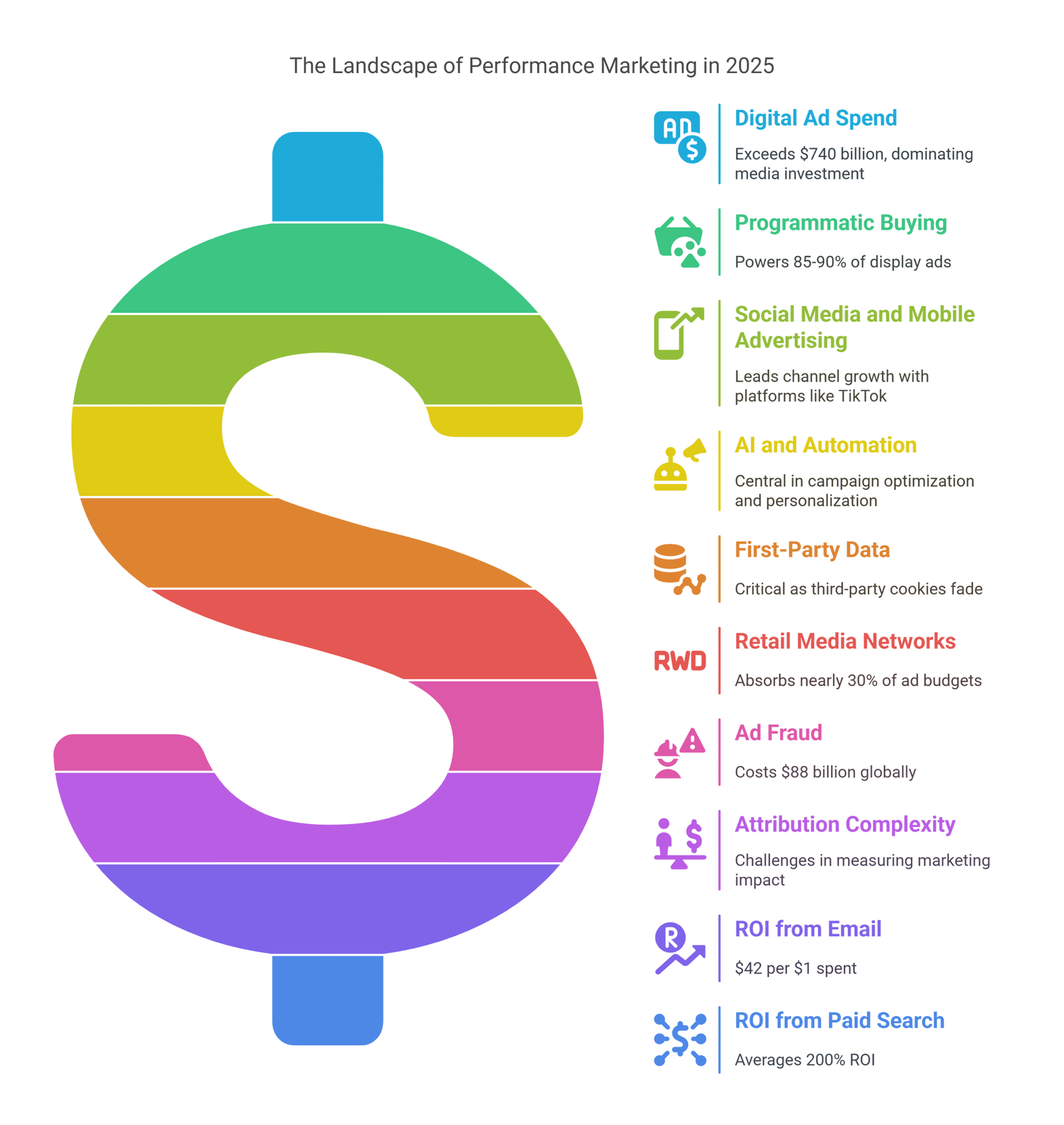
- Global digital ad spend expected to reach $740 billion–$843 billion in 2025—marking a ~6–12% increase year-over-year.
- Digital ads will account for approximately 62–70% of all global ad spend, with mobile ads comprising ~70–77%, and video spending over $150 billion .
Performance-Centric Channels
- Programmatic advertising now dominates: 85–90% of display purchases are automated, with projected spend hitting $725 billion by 2025.
- Social media ad revenue is forecast at ~$250–310 billion in 2025.
- Short-form videos (TikTok, Reels, Shorts) take center stage:
- Account for 60–80%+ of video formats, with video landing pages converting 80% better. (Source)
- Short clips (<60 s) drive 112% better recall.
Tech & Tooling Trends
- AI, automation & ML are now core to performance marketing:
- Tools like Google Performance Max and Facebook Advantage+ are widely adopted. (Source)
- 70%+ of marketers allocating budgets to AI; 40% actively use Generative AI (accio.com).
- First-party data strategies are essential due to cookieless shifts—over 48% of personalization leaders exceeding revenue goals by using proprietary data.
- Retail media networks (RMNs)—like Amazon and Walmart—are projected to make up 30% of digital ad spend by 2025.
- Voice-search and conversational AI are growing—35% of U.S. households use smart speakers, and ~18% year-over-year voice-search increase .
ROI & Channel Performance
- Paid search ROI averages ~200%, with 50% higher conversion than display.
- Display ad CPC averages ~$0.63, while Google search CPC is $2.69. (Source)
- Programmatic video ads yield ~20% higher ROI over traditional display.
- Email marketing returns ~$42 per $1 spent.
Risks & Infrastructure
- Ad fraud remains a major threat: ~11.5% of search ads are fraudulent, with $88 billion lost in 2023—and projected to reach $172 billion by 2028 en.wikipedia.org.
- Ad tech inefficiencies: managing multi-platform campaigns can incur 20–30% waste, mitigated by unified consoles reducing inefficiencies by 41% medium.com.
At-a-Glance Snapshot
| Area | 2025 Insight |
| Global Digital Ad Spend | $740–843B (62–70% of all ad spend) |
| Mobile Ads | 70–77% of digital spend |
| Social Media Ads | $250–310B |
| Programmatic Buying | 85–90% of display; $725B in spend |
| Video & Short-form Ads | >80% traffic; ~112% better recall |
| AI & Automation | 70%+ budgeted; GenAI growing; programmatic’s foundation |
| First-party Data | >48% exceed revenue goals using it |
| RMNs | 30% of total ad spend |
| Ad Fraud | $88B lost in 2023; 11.5% search ads fraudulent |
| CPC & ROI Averages | Search CPC $2.69, display CPC $0.63; paid search ROI 200%; email ROI $42/$1 |
These verified stats illustrate how performance marketing drives the digital economy in 2025: dominant ad spend, AI-powered performance, and measurable ROI, tempered by data challenges and fraud. Stay strategic, stay data-driven.
Summary of Data
In 2025, performance marketing has become a dominant force in digital advertising, with global digital ad spend surpassing $740 billion and accounting for over 60% of total media investment. Programmatic buying powers 85–90% of display ads, while social media and mobile advertising lead channel growth, driven by platforms like TikTok, Instagram, and Amazon. AI and automation now play a central role in campaign optimization, helping marketers personalize content and scale efficiently. First-party data has become critical as third-party cookies fade, and retail media networks (RMNs) now absorb nearly 30% of ad budgets. Despite these advances, challenges like ad fraud—costing $88 billion globally—and attribution complexity persist. Still, with ROI from channels like email ($42 per $1 spent) and paid search (averaging 200% ROI), performance marketing continues to deliver high-impact, measurable growth for data-driven brands.
Conclusion: So, What is Performance Marketing? Your New Digital Growth Ally
Let’s bring it back to the question at the heart of this entire strategy: What is performance marketing?
It’s more than just a buzzword—it’s a modern, data-driven approach to digital marketing where you only pay when real results happen. Clicks. Leads. Sales. That’s it. No fluff. No vanity metrics. Just pure, trackable outcomes that move your business forward.
Performance marketing empowers brands to:
- Spend smarter
- Track deeper
- Adapt faster
- Scale easier
Whether you’re running a lean startup or managing a multi-million-dollar campaign, this approach helps ensure every dollar you invest is tied directly to business growth.
And in a digital world that’s always shifting—where privacy laws tighten, platforms evolve, and audiences demand relevance—performance marketing gives you the flexibility and focus to thrive, not just survive.
What Are the Best Social Media Platforms for Marketing?
So, the next time someone asks “What is performance marketing?”
You’ll know exactly what to say:
“It’s the smartest way to spend a digital dollar.”
Frequently Asked Questions About Performance Marketing
What is performance marketing in simple terms?
It’s a marketing strategy where you pay only when a specific action—like a click, lead, or sale—takes place.
Is performance marketing the same as affiliate marketing?
No. Affiliate marketing is a type of performance marketing. Performance marketing includes affiliates, paid search, social ads, and more.
What makes performance marketing different from traditional marketing?
Traditional marketing pays for exposure. Performance marketing pays for measurable results, making ROI easier to track and optimize.
What digital channels are used in performance marketing?
Popular channels include:
- Paid search (PPC)
- Social media advertising
- Affiliate networks
- Native ads
- Email marketing
Is performance marketing suitable for small businesses?
Yes! It’s especially effective for small businesses because it minimizes risk—you only pay when you get results.
How do you measure success in performance marketing?
Through metrics like:
- Cost per acquisition (CPA)
- Click-through rate (CTR)
- Return on investment (ROI)
- Conversion rate