







I still remember the day I discovered Semrush as a keyword research tool. My ROI in marketing was drowning, one tool for keyword research, another for backlink analysis, a third for rank tracking, and yet another for competitor analysis. I was spending over $600 monthly on fragmented tools that didn’t talk to each other. Then I tested Semrush during a client emergency when I needed to salvage a website that had dropped 60% in organic traffic overnight. Within three hours of using the platform, I identified 47 technical SEO issues, discovered 12 high-value keyword opportunities some of my competitors were ranking for, and built a recovery roadmap. Six months later, that client’s organic traffic had increased by 347%.
That experience transformed how I approach digital marketing. But Semrush isn’t cheap, and with so many SEO tools flooding the market in 2025.
This publication is my honest and comprehensive Semrush review based on two years of daily usage across 23 client websites. This review examines features, pricing, real applications, and whether Semrush delivers enough value to justify its premium price tag. So, suppose you’re a marketing executive evaluating tools for your team, an agency owner managing multiple clients, or a small business founder trying to compete online. In that case, this review will help you make an informed decision.
What Is Semrush and Why Do Marketers Choose It?
Semrush is an all-in-one digital marketing platform that combines 55+ tools for SEO, content marketing, competitor research, PPC advertising, and social media management into a single subscription. Unlike specialized tools that focus on one function, Semrush positions itself as a comprehensive marketing suite that eliminates the need for multiple subscriptions.
Founded in 2008, Semrush has grown to serve over 10 million users globally across 142 countries. The platform caters to diverse industries, including e-commerce businesses, digital marketing agencies, SaaS companies, publishers, and enterprise organizations. What started as a keyword research tool has evolved into a complete competitive intelligence and marketing workflow platform.
In 2025, Semrush introduced significant updates that strengthened its market position. The keyword database now contains over 27 billion keywords – the largest in the industry. The backlink index tracks 43 trillion backlinks, providing unmatched depth for link analysis. The platform has also integrated AI-powered features, including ContentShake AI for automated content generation and an AI Writing Assistant that provides real-time optimization suggestions.
What distinguishes Semrush from competitors is its focus on competitive intelligence. Every tool is designed to answer not just “how is my website performing?” but also “how do I compare to competitors, and what opportunities are they missing?” This competitive lens makes Semrush particularly valuable for agencies and businesses operating in saturated markets where understanding the competitive landscape determines success or failure.
The platform serves marketing professionals who need data-driven insights to make strategic decisions, track ROI, and demonstrate value to stakeholders or clients. For solo marketers wearing multiple hats, Semrush consolidates workflows that would otherwise require constant tool-switching and data reconciliation.
5 Standout Features and Tools in Semrush
I’ve tested dozens of SEO tools in the past, and what consistently brings me back to Semrush is the depth and breadth of its feature set. Let me walk you through the tools I use daily and how they’ve delivered tangible results for my clients.
-
Keyword Research and Analysis
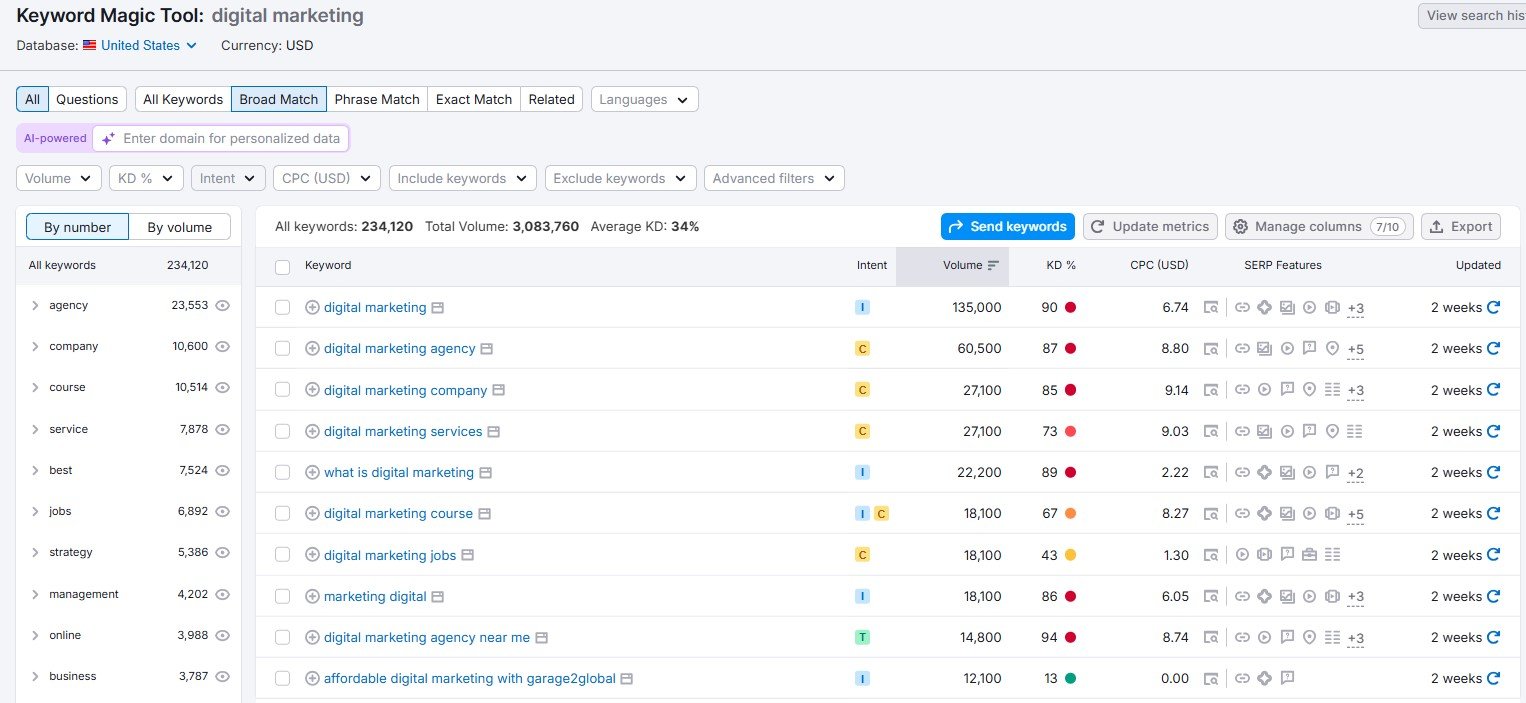
The Keyword Magic Tool remains Semrush’s crown jewel. With access to 27 billion keywords across 142 databases, I can research virtually any market or niche. The tool displays essential metrics, including monthly search volume, keyword difficulty scores, cost-per-click data for paid campaigns, and SERP features currently ranking for each keyword. What I appreciate most is the filtering system – I can quickly isolate low-competition keywords with high commercial intent, which consistently delivers the best ROI for clients.
The Keyword Gap tool has saved me countless hours of competitive analysis. I input my client’s domain alongside up to four competitors, and the tool reveals keywords where competitors rank but my client doesn’t. Last quarter, I used this feature for an e-commerce client and discovered 89 product-related keywords their main competitor was ranking for. Within four months of targeting those gaps, my client captured page one positions for 67 of those terms.
The Organic Research tool provides a comprehensive view of any competitor’s organic search strategy. I can see their top-ranking pages, estimated organic traffic, keyword positions, and traffic trends over time. This intelligence informs content strategy and helps me identify which competitor tactics are working versus which are declining.
-
Backlink Intelligence
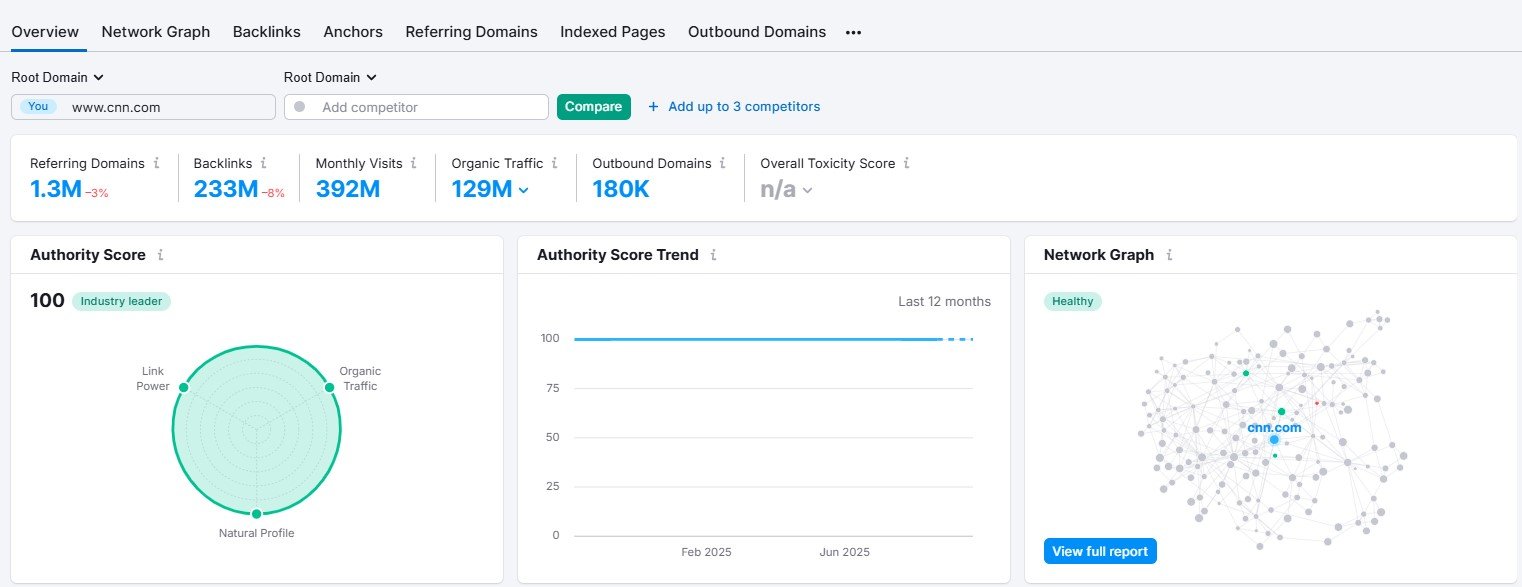
For backlink analysis, Semrush’s database of 43 trillion backlinks provides unprecedented visibility. The Backlink Analytics tool shows referring domains, anchor text distribution, Authority Scores for linking sites, and flags potentially toxic links that could trigger Google penalties. I’ve used this tool to audit new client websites and consistently discover harmful links they weren’t aware of.
The Authority Score metric, which Semrush developed as an alternative to other domain authority metrics, ranges from 0-100 and provides a quick snapshot of a domain’s overall quality and ranking power. While no third-party metric perfectly mirrors Google’s algorithm, I’ve found Authority Score to be reliably predictive of ranking potential.
The Backlink Gap analysis mirrors the keyword version – it identifies websites linking to competitors but not to your site. This creates a targeted prospecting list for outreach campaigns. I recently used this for a B2B SaaS client and identified 34 industry websites linking to three competitors. After personalized outreach, we secured links from 11 of those sites within two months.
-
Technical SEO and Site Auditing
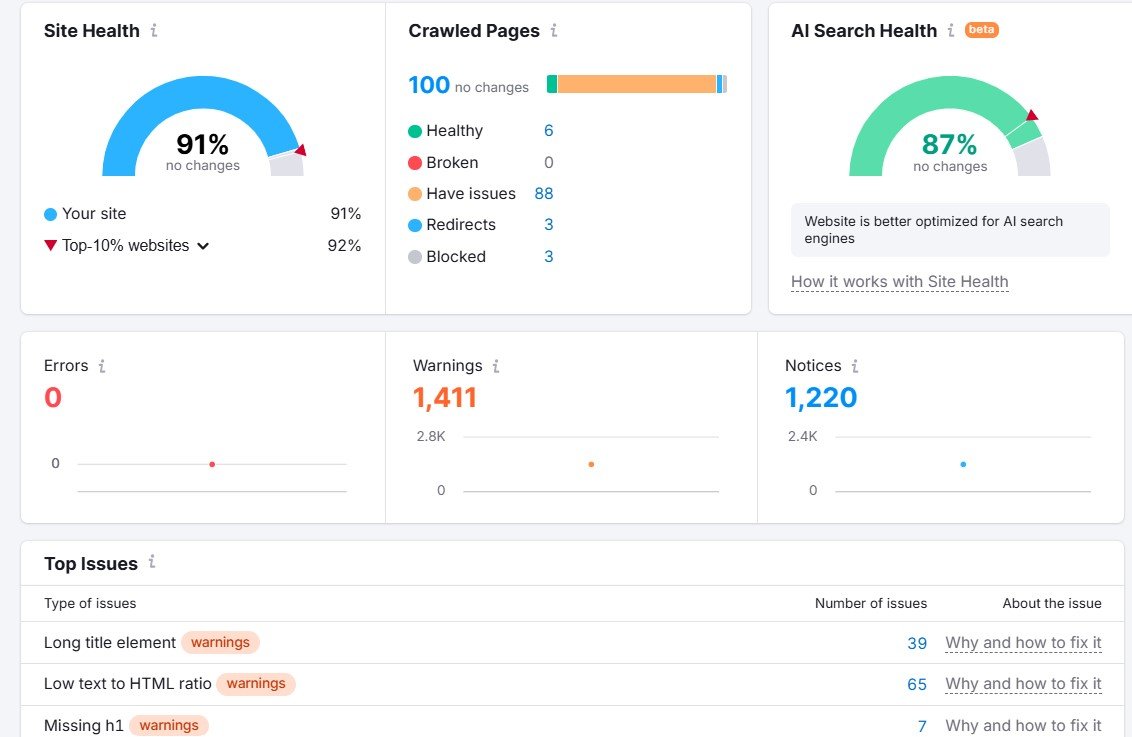
semrush site audit showing an audited dashboard of a website.
The Site Audit tool crawls up to 20,000 URLs (depending on your plan) and identifies 140+ technical issues that could harm search performance. Issues are categorized by severity – errors, warnings, and notices – which helps prioritize fixes. The tool checks for broken links, duplicate content, missing meta tags, page speed issues, mobile usability problems, and structured data errors.
I run site audits monthly for all clients, and the automated reports track improvements over time. For one client, we increased their site health score from 67% to 94% over six months by systematically addressing the issues Semrush identified. That correlated with a 156% increase in organic traffic.
The On-Page SEO Checker provides page-specific optimization recommendations based on current top 10 competitors for your target keyword. It analyzes semantic keywords, content length, readability, backlinks, and technical factors, then provides actionable suggestions. This feature alone has reduced my content optimization time by about 40%.
-
AI-Powered Content Tools
Semrush’s integration of AI tools in 2025 represents a significant evolution. ContentShake AI generates content outlines, first drafts, and optimization suggestions based on competitive analysis. While I never publish AI content without substantial human editing and expertise, the tool accelerates the research and outlining phase considerably.
The SEO Writing Assistant integrates directly into Google Docs and WordPress. As I write, it provides real-time feedback on keyword usage, readability scores, tone consistency, and content originality. The tool compares my draft against top-ranking competitors and suggests improvements. For teams without dedicated SEO specialists, this real-time guidance prevents common optimization mistakes.
-
Competitive Analysis Suite
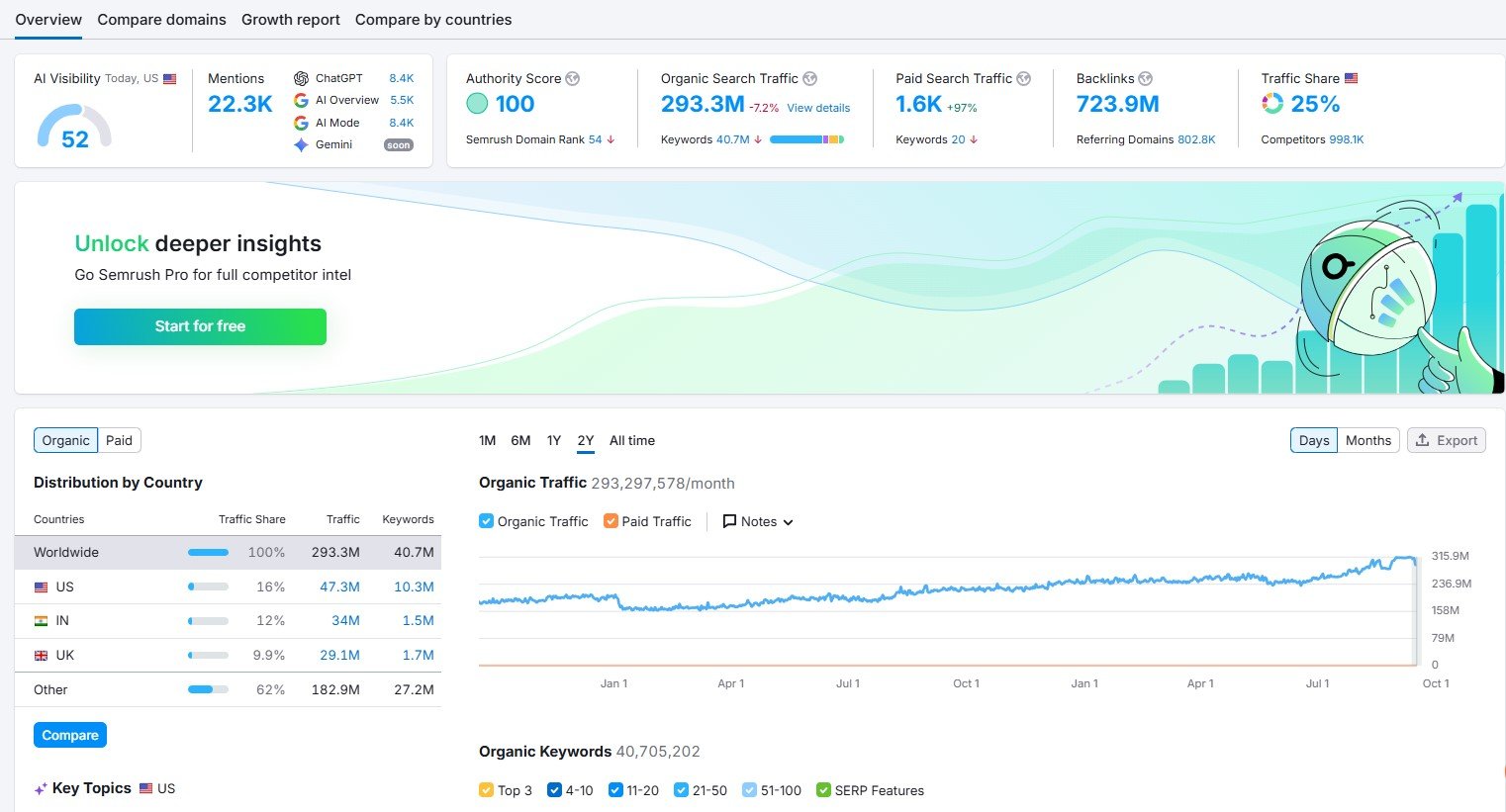
complete somain overview of BBC using semrush abakysis suite
The Domain Overview tool provides a competitive intelligence dashboard showing organic and paid search performance, traffic estimates, top keywords, main competitors, and backlink metrics for any domain. I start every new client relationship with a Domain Overview analysis of their top five competitors. This 30-minute exercise typically reveals market positioning insights that shape our entire strategy.
Traffic Analytics estimates website traffic, engagement metrics, traffic sources, and audience demographics for any competitor. While estimates aren’t perfect, they provide directional insights that help benchmark performance. I’ve used this to identify which competitor marketing channels are driving the most traffic, then investigate their tactics on those channels.
The PPC Keyword Tool analyzes competitor paid search campaigns, revealing their target keywords, ad copy, budget estimates, and landing pages. For clients running Google Ads, this competitive intelligence prevents wasted spend on ineffective keywords and identifies gaps in competitor campaigns we can exploit.
The Pros and Cons of Semrush
After two years of daily Semrush usage across multiple client accounts, I’ve developed a clear understanding of where the platform excels and where it falls short. Let me share both sides honestly.
Advantages of Semrush
The keyword and backlink databases are genuinely the largest I’ve encountered. For international clients or those in niche markets, this depth matters significantly. I’ve compared keyword data between Semrush, Ahrefs, and Moz for the same search terms, and Semrush consistently returns more keyword variations and long-tail opportunities.
The all-in-one approach delivers real efficiency gains. Before Semrush, I used separate subscriptions for keyword research, rank tracking, backlink analysis, and site auditing. Consolidating into Semrush eliminated the need to export data from multiple platforms, reconcile different metrics, and train team members on various interfaces. This consolidation saves my team approximately 15 hours weekly.
The AI features introduced in 2025 provide genuine value when used appropriately. I don’t rely on AI for final content, but ContentShake significantly accelerates research and outlining. The SEO Writing Assistant catches optimization opportunities I might miss during deadline pressure.
Usage limits are generous compared to competitors. Semrush allows 3,000 to 5,000 reports per day, depending on your plan, whereas some competitors restrict you to a few hundred. For agencies running multiple audits and analyses daily, these limits matter.
The competitor analysis tools consistently reveal actionable insights. I can’t count how many client strategies have been shaped by discovering competitor keyword gaps, backlink opportunities, or content themes that were outperforming our approach.
Semrush releases updates regularly. Features I use today didn’t exist 18 months ago. This commitment to evolution means the platform improves rather than stagnates.
The educational resources through Semrush Academy are genuinely valuable. The free certification courses in SEO, content marketing, and PPC advertising provide structured learning for team members. I’ve had two junior team members complete these certifications, and the training noticeably improved their work quality.
Disadvantages of Semrush
The pricing represents a significant barrier, especially for freelancers and small businesses. At $139.95 monthly for the entry-level Pro plan, Semrush costs substantially more than competitors like SE Ranking ($55/month) or Mangools ($49/month). For established agencies and businesses, this premium is justifiable. For solopreneurs just starting, it’s prohibitive.
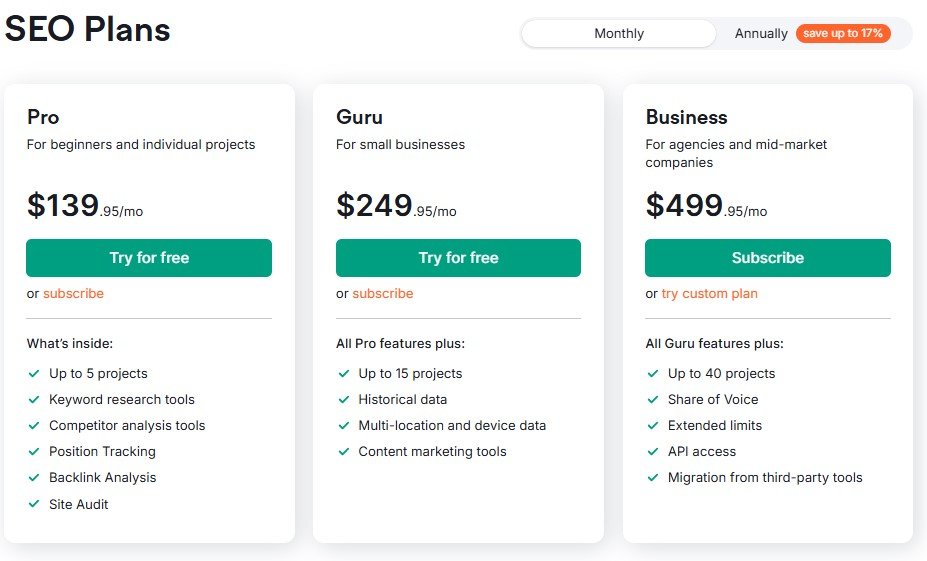
The Pro plan’s single-user limit frustrates small teams. If you have even two people who need access, you must upgrade to the Guru plan at $249.95 monthly. This doubles your cost simply to add one more user seat.
The learning curve is genuinely steep. When I onboard new team members, I budget 8-10 hours of training before they can use Semrush independently. The interface contains so many features that it feels overwhelming initially. New users often don’t know where to start or which tools address their specific needs.
Some reports load slowly during peak usage times. This isn’t a daily problem, but I’ve experienced 30-60 second wait times for complex competitor analyses during U.S. business hours. This interrupts workflow momentum.
Project limits on lower-tier plans restrict scalability. The Pro plan includes only five projects, which means agencies managing six or more client websites must immediately upgrade to Guru (15 projects) or Business (40 projects). This forces earlier plan upgrades than competitors with more generous project allocations.
The interface density sometimes creates information overload. Semrush displays enormous amounts of data, and identifying the most relevant insights requires experience. I’ve watched new users stare at a data-filled dashboard without knowing which metrics actually matter for their goals.
Semrush Pricing Plans and Cost Analysis 2025
Pricing often determines whether Semrush is feasible for your situation, so let me break down the costs and value proposition for each tier based on my experience managing accounts at different levels.
Pricing Structure
The Pro Plan costs $139.95 per month or $117.33 monthly if billed annually. This plan includes five projects, tracking for 500 keywords, 10,000 results per report, and one user seat. For solo marketers or freelancers managing a handful of websites, Pro provides core functionality.
The Guru Plan costs $249.95 per month or $208.33 monthly when billed annually. Guru expands to 15 projects, 1,500 tracked keywords, 30,000 results per report, and three user seats. Critically, Guru unlocks the Content Marketing Toolkit and historical data, which Pro lacks. For content-focused strategies or agencies needing historical trend analysis, these features justify the upgrade.
The Business Plan costs $499.95 monthly or $416.66 monthly with annual billing. This tier provides 40 projects, 5,000 tracked keywords, 50,000 results per report, five user seats, and API access for custom integrations. Business also includes extended limits across all tools. Mid-sized agencies typically operate at this level.
The Enterprise Plan uses custom pricing based on your specific requirements. Enterprise includes white-label solutions for agency reporting, dedicated account management, unlimited projects, premium support, and extensive customization options. This tier serves large agencies and enterprise organizations.
Is Semrush Worth the Cost?
This question depends entirely on your situation and alternative costs. For my agency managing 12 active client websites, the Guru plan at $2,500 annually replaces what was previously four separate subscriptions totaling approximately $4,800 annually. The consolidation delivers $2,300 in direct savings plus the workflow efficiency gains I mentioned earlier.
Annual billing saves approximately 17% compared to monthly subscriptions. If you’re confident you’ll use Semrush for at least six months, annual billing makes financial sense. The 7-day money-back guarantee on annual plans provides an escape option if the platform doesn’t meet expectations.
Semrush offers a 7-day free trial for Pro and Guru plans. The trial requires a credit card, but you can cancel before the trial period ends. I recommend using those seven days intensively – run complete audits on your websites, perform competitor analyses, and test the workflow with your actual projects. Seven days provides sufficient time to determine whether Semrush fits your needs.
The refund policy allows refund requests within seven calendar days of purchase for annual subscriptions bought directly through Semrush.com. Monthly subscriptions don’t qualify for refunds. Processing takes 3-5 business days typically, though some users report delays up to 30 days.
When comparing costs, Semrush pricing runs 15-20% higher than SE Ranking but offers significantly more comprehensive features and a larger database. Against Ahrefs at similar pricing, Semrush provides superior PPC tools and broader marketing features, while Ahrefs focuses more narrowly on SEO and backlinks.
For freelancers managing 1-3 websites with tight budgets, Semrush Pro may exceed what’s necessary. Tools like SE Ranking, Mangools, or Ubersuggest deliver adequate functionality at lower price points. For agencies managing multiple clients, established businesses with competitive markets, or companies consolidating marketing tools, Semrush typically delivers positive ROI within the first quarter.
Semrush vs Competitors: Which SEO Tool Is Best?
I’ve tested virtually every major SEO tool over my career, and clients regularly ask how Semrush compares to alternatives. Here’s my honest assessment based on hands-on usage.
| Feature | Semrush | Ahrefs | Moz Pro | SE Ranking |
| Starting Price | $139.95/mo | $129/mo | $99/mo | $55/mo |
| Annual Price | $1,408/yr | $1,548/yr | $948/yr | $480/yr |
| Keyword Database | 27B+ keywords | 10B+ keywords | 1.25B keywords | 7B+ keywords |
| Backlink Index | 43T backlinks | 36T backlinks | 40B backlinks | 4T backlinks |
| Projects (Base Plan) | 5 projects | 5 projects | 3 campaigns | 10 projects |
| User Seats (Base) | 1 user | 1 user | 1 user | 1 user |
| AI Content Tools | Yes (ContentShake) | Limited | No | Limited |
| PPC Analysis | Comprehensive | Limited | Limited | Yes |
| Content Marketing | Full toolkit | Basic | Limited | Basic |
| Historical Data | Guru+ only | All plans | All plans | All plans |
| Best For | Agencies, All-in-one | Backlink focus | Beginners | Budget-conscious |
Semrush vs Ahrefs
This comparison dominates SEO tool discussions because both platforms occupy similar price points and target similar users. I maintain subscriptions to both, and they serve different strengths.
Semrush provides superior PPC advertising tools. If you run Google Ads campaigns or need to analyze competitor paid strategies, Semrush delivers functionality that Ahrefs simply doesn’t offer. The PPC Keyword Tool, Ad Builder, and competitive ad analysis are comprehensive.
Semrush’s AI features introduced in 2025 give it an edge for content creation workflows. ContentShake and the SEO Writing Assistant accelerate content production in ways Ahrefs hasn’t matched. For content-heavy strategies, this matters.
Ahrefs provides a more intuitive interface for backlink analysis. The way Ahrefs visualizes link profiles and anchor text distributions feels cleaner and easier to interpret. Ahrefs also crawls websites faster – their Site Audit tool typically completes in roughly half the time Semrush requires.
Ahrefs includes historical data at all plan levels, while Semrush restricts this to Guru plans and above. If you need to analyze ranking trends over time on the base plan, Ahrefs provides better value.
The keyword database size heavily favors Semrush – 27 billion versus 10 billion keywords. For international markets or long-tail research, Semrush uncovers opportunities that Ahrefs misses.
My recommendation: Choose Semrush if you need all-in-one marketing functionality including PPC, content tools, and the largest keyword database. Choose Ahrefs if you prioritize backlink analysis specifically and prefer a simpler, more focused interface.
Semrush vs Moz Pro
Moz Pro targets beginners and small businesses with simpler interface design and lower pricing at $99 monthly. However, the feature gap is substantial. Moz’s keyword database contains only 1.25 billion keywords compared to Semrush’s 27 billion. The backlink index is dramatically smaller – 40 billion versus 43 trillion.
Moz excels at providing clear, actionable recommendations without overwhelming users. If you’re new to SEO and intimidated by data-heavy interfaces, Moz offers a gentler learning curve. The Domain Authority metric Moz developed remains widely recognized in the industry.
For established marketers or agencies, Moz’s limitations become apparent quickly. The tool lacks depth for comprehensive competitive analysis, provides limited international data, and offers basic PPC functionality. I started my career using Moz but outgrew it within 18 months as client needs became more sophisticated.
Semrush vs SE Ranking
SE Ranking costs $55 monthly for the Essential plan, making it less than half the price of Semrush Pro. The platform provides solid core functionality including keyword research, rank tracking, backlink analysis, and site audits. For small businesses and freelancers on strict budgets, SE Ranking delivers respectable value.
However, the database sizes differ dramatically. SE Ranking tracks 7 billion keywords and 4 trillion backlinks – substantial, but roughly one-quarter of Semrush’s scope. In competitive markets or when researching international keywords, these gaps become noticeable.
SE Ranking lacks the AI-powered features, comprehensive PPC tools, and content marketing suite that Semrush provides. The interface feels less polished, and some reports load slowly. Customer support response times also lag behind Semrush.
My take: SE Ranking suits budget-conscious users who need basic SEO functionality without premium features. Semrush justifies its higher cost for users who need comprehensive data, advanced features, and professional-grade tools.
Semrush vs SpyFu
SpyFu specializes in competitor PPC research, particularly for U.S. markets. It provides extensive historical data on competitor ad campaigns, including every keyword they’ve purchased, every ad variation they’ve tested, and estimated budget allocations. For U.S.-focused PPC competitive intelligence, SpyFu offers impressive depth.
However, SpyFu’s international coverage is weak compared to Semrush’s 142-country database. SpyFu also provides limited SEO features – basic keyword research and rank tracking, but nothing approaching Semrush’s comprehensive SEO toolkit.
SpyFu costs $39 monthly for the Basic plan, making it significantly cheaper than Semrush. If your primary need is competitive PPC analysis for U.S. campaigns and you have separate SEO tools, SpyFu delivers strong value. For comprehensive marketing needs, Semrush remains the better choice.
Is Semrush Right for Your Business?
Not everyone needs Semrush, and the platform isn’t the best choice for every situation. Let me outline who benefits most and who should consider alternatives.
Ideal Semrush Users
Digital marketing agencies managing multiple client accounts represent Semrush’s core audience. The ability to organize separate projects for each client, generate white-label reports, and access comprehensive tools for diverse client needs makes Semrush well-suited for agency workflows. My agency operates at the Business plan level specifically because managing 12 client websites demands the project limits and user seats that tier provides.
SEO professionals who live in keyword research and competitive analysis daily will maximize Semrush’s value. If identifying keyword opportunities, analyzing SERP competition, and tracking ranking movements forms your core work, the depth and accuracy of Semrush’s data justifies the investment.
Content marketers benefit significantly from the Content Marketing Toolkit and AI features. The SEO Writing Assistant, content templates, topic research tools, and post tracking streamline content workflows from ideation through optimization. I’ve reduced content production time by approximately 35% using these features.
E-commerce businesses competing in product-heavy markets need the comprehensive keyword research and competitor tracking Semrush provides. Understanding which product keywords competitors rank for, which content strategies drive their traffic, and which PPC campaigns they’re running informs effective e-commerce SEO strategies.
Enterprise companies requiring API access, custom integrations, and white-label solutions find these capabilities at the Business and Enterprise tiers. Large organizations with complex marketing technology stacks can integrate Semrush data into custom dashboards and reporting systems.
Small to medium businesses with monthly marketing budgets exceeding $5,000 typically generate positive ROI from Semrush. At this budget level, the insights gained from competitive intelligence and the efficiency from consolidated tools deliver measurable returns.
Who Should Consider Alternatives
Freelancers and solopreneurs operating on tight budgets may find Semrush Pro at $140 monthly exceeds what’s justifiable, especially when managing only 1-3 websites. Tools like SE Ranking at $55 monthly or Mangools at $49 monthly provide adequate functionality for basic SEO needs without the premium cost.
Complete beginners without SEO experience often feel overwhelmed by Semrush’s interface complexity. The learning curve requires significant time investment. Simpler platforms like Moz Pro or Ubersuggest provide more accessible entry points for learning SEO fundamentals.
Businesses focused exclusively on backlink analysis and not needing broader marketing features might find Ahrefs more cost-effective. Ahrefs’ specialized focus on link analysis, combined with its more intuitive backlink interface, serves single-function needs more efficiently.
Local businesses with purely local SEO needs may not require Semrush’s extensive international database and advanced features. Local-focused tools or even well-optimized use of free resources like Google Business Profile and Google Search Console often suffice for purely local strategies.
Some Examples For You
Let me share a concrete example. I manage an e-commerce client selling outdoor recreation equipment. They operate in a highly competitive market with established competitors spending six figures monthly on SEO and paid advertising. Using Semrush, I identified 127 product-related keywords where their three main competitors all ranked in the top 10, but my client had no visibility. I prioritized the 40 keywords with the highest commercial intent and lowest competition.
Over six months, we created optimized product pages and content targeting those 40 keywords. Semrush’s Position Tracking tool monitored our progress weekly. We captured page one positions for 31 of those 40 target keywords. The Organic Research tool showed competitor traffic declining slightly during this period, indicating we were capturing their market share. That keyword targeting strategy generated approximately $240,000 in additional revenue during those six months. The annual Guru plan cost $2,500. The ROI calculation speaks for itself.
That’s the value proposition Semrush delivers for businesses competing in established markets where understanding and outmaneuvering competitors determines success. For businesses not facing that level of competition or lacking the resources to execute on competitive insights, simpler tools often suffice.
Pro Tips for Maximizing Semrush ROI
If you decide Semrush fits your needs, here’s how to extract maximum value based on what I’ve learned through extensive usage.
Getting Started Effectively
Take advantage of the 7-day free trial, but use it strategically. Don’t just browse features casually. Import your actual websites, run complete site audits, perform keyword research for your real projects, and analyze your actual competitors. This hands-on testing with your real work reveals whether the platform fits your workflow.
Complete the Semrush Academy courses during your first month. The SEO Fundamentals, Keyword Research, and Content Marketing certifications are free and provide structured training on leveraging Semrush features effectively. I require all agency team members to complete these courses, and it noticeably improves their proficiency.
Set up your first project within 24 hours of subscribing. Add your website, configure Position Tracking for your priority keywords, and run the initial Site Audit. These baseline measurements allow you to track improvements over time and demonstrate ROI to stakeholders.
Workflow Efficiency Strategies
Automate report generation and email delivery. Semrush allows scheduled reports sent automatically to clients or team members weekly or monthly. I’ve configured automated reports for all client sites showing ranking changes, traffic trends, and site health scores. This automation saves approximately 6 hours monthly that I previously spent generating manual reports.
Use Keyword Magic Tool filters aggressively to isolate opportunities quickly. Rather than scrolling through thousands of keyword suggestions, I filter for keywords with search volume above 500, keyword difficulty below 50, and specific keyword types like questions or product-focused terms. These filtered views reveal actionable opportunities within minutes.
Batch export competitor data quarterly and create competitor intelligence reports. Rather than running one-off competitor analyses reactively, I schedule quarterly deep dives where I export comprehensive data on top competitors, identify emerging trends, and adjust strategies proactively. This disciplined competitive monitoring prevents surprises.
Integrate Semrush with Google Analytics and Google Search Console. These free integrations unify your data sources within Semrush dashboards. You can compare Semrush’s keyword and traffic estimates against actual Google data, which improves accuracy and provides comprehensive performance visibility.
Leverage the AI content tools appropriately. I use ContentShake for initial research and outlining, then add expertise, experience, and original insights manually. The AI accelerates the research phase but can’t replace subject matter expertise or original thinking. Treat AI as a research assistant, not a content creator.
Budget Optimization Tactics
Choose annual billing to save 17% on your subscription cost. This delivers $264 annual savings on the Pro plan, $498 savings on Guru, and $996 savings on Business. If you’re confident you’ll use Semrush for at least seven months, annual billing pays for itself.
Consolidate redundant tools that Semrush replaces. Audit your current marketing technology stack and cancel subscriptions that Semrush duplicates. Before Semrush, my agency subscribed to separate keyword research, rank tracking, backlink analysis, and site audit tools. Consolidating into Semrush eliminated four subscriptions, delivering net savings despite Semrush’s premium pricing.
Use project slots strategically when approaching plan limits. If you’ve exhausted your project allocation, you can archive dormant projects temporarily to free slots for active work. I rotate projects seasonally for clients with distinct peak seasons, archiving their project during off-seasons and reactivating when needed.
Consider team members’ actual usage before adding user seats. The single user limit on Pro frustrates some buyers, but honestly assess whether multiple team members need simultaneous access. In some cases, team members can share login credentials for sequential usage rather than paying for concurrent access. While Semrush’s terms of service technically limit this, small teams often share access pragmatically.
Request quotes for custom plans when standard tiers almost fit your needs. Semrush sales representatives have flexibility to create modified plans for businesses with specific requirements. I’ve negotiated custom project limits and user seats when standard tiers didn’t align perfectly with client needs.
Frequently Asked Questions
Is Semrush worth the money in 2025?
Yes, Semrush is worth the investment for businesses and agencies that need comprehensive SEO and marketing tools. The platform consolidates multiple specialized tools into a single subscription, typically saving users $500 to $1,200 monthly compared to purchasing separate services for keyword research, rank tracking, backlink analysis, site auditing, and competitor intelligence. For my agency, Semrush replaced four separate subscriptions while delivering superior functionality, resulting in net annual savings of approximately $2,300 plus significant workflow efficiency gains.
However, for freelancers managing only 1-2 websites or small businesses with limited budgets and basic SEO needs, cheaper alternatives like SE Ranking, Mangools, or Ubersuggest may provide adequate functionality at lower price points. The value equation depends on your specific situation, budget, and sophistication of your marketing needs.
Does Semrush offer a free trial?
Yes, Semrush offers a 7-day free trial for both the Pro and Guru plans. A credit card is required to start the trial, but you can cancel before the trial period ends to avoid charges. I strongly recommend using those seven days intensively – run complete site audits on your websites, perform thorough competitor analyses, test the keyword research tools, and evaluate whether the workflow fits your needs. Seven days provides sufficient time to make an informed decision.
Be aware that some advanced features are restricted during the trial period, and you’ll need to subscribe to access full functionality. Set a calendar reminder for day six of your trial so you don’t forget to cancel if you decide the platform isn’t right for you.
Can I get a refund if I don’t like Semrush?
Semrush has a 7-day money-back guarantee for annual subscriptions purchased directly through Semrush.com. You must submit a refund request within seven calendar days of your initial purchase. Refunds are not available for month-to-month subscriptions or for subscriptions purchased through third-party resellers. The refund process typically takes 3-5 business days, though some users report delays up to 30 days depending on your payment method.
This refund policy creates a risk-free trial period for annual subscriptions. If you’re uncertain whether Semrush meets your needs, purchasing an annual subscription, testing thoroughly for a week, and requesting a refund if dissatisfied provides more evaluation time than the 7-day free trial alone.
Is Semrush better than Ahrefs?
Semrush and Ahrefs excel in different areas, so “better” depends on your priorities. Semrush offers superior PPC advertising tools, AI-powered content features, and a significantly larger keyword database (27 billion versus 10 billion keywords). Semrush functions as a comprehensive marketing platform addressing SEO, content marketing, PPC, social media, and competitive intelligence.
Ahrefs provides a more intuitive interface specifically for backlink analysis, faster site crawling speeds, and includes historical data at all plan levels (whereas Semrush restricts historical data to Guru plans and above). Ahrefs focuses more narrowly on SEO and link building.
I maintain subscriptions to both platforms because they serve complementary purposes. Choose Semrush if you need all-in-one marketing functionality and comprehensive keyword research. Choose Ahrefs if you prioritize backlink analysis specifically and prefer a simpler, more specialized tool. For agencies and businesses needing diverse marketing capabilities, Semrush typically provides better overall value.
Is Semrush beginner-friendly?
Honestly, no – Semrush has a steep learning curve and can be overwhelming for complete beginners. The platform contains 55+ tools, and the interface displays dense data that requires SEO knowledge to interpret meaningfully. When I onboard new team members, I budget 8-10 hours of training before they can use Semrush independently and effectively.
However, Semrush provides extensive educational resources to help beginners climb that learning curve. The Semrush Academy offers free certification courses in SEO fundamentals, keyword research, content marketing, and technical SEO. The knowledge base contains hundreds of tutorial articles and videos. Customer support responds to questions reasonably quickly.
If you’re completely new to SEO, I recommend starting with simpler platforms like Moz Pro or Ubersuggest to learn fundamentals, then transitioning to Semrush once you understand core SEO concepts. Alternatively, invest time upfront in Semrush Academy courses to build foundational knowledge while learning the platform.
How accurate is Semrush data?
Semrush provides highly accurate data for keyword research, search volume estimates, and backlink analysis, but like all SEO tools, metrics are estimates based on clickstream data, algorithms, and statistical models – not direct access to Google’s data. When I’ve compared Semrush’s organic traffic estimates to actual Google Analytics data, the accuracy rate is approximately 85-92% for established websites.
Keyword search volume estimates from Semrush typically align closely with Google Ads Keyword Planner data, though both sources show variations. Backlink data accuracy depends on crawl frequency – Semrush updates its index regularly, but some backlinks may not appear immediately after being placed.
I always cross-reference Semrush data with Google Search Console and Google Analytics for critical business decisions. Semrush excels at competitive intelligence and uncovering opportunities, while Google’s first-party data provides definitive performance measurements for your own websites.
Can I use Semrush for local SEO?
Yes, Semrush offers robust local SEO features including location-specific keyword tracking, Google Business Profile integration, Listing Management tools, and rank tracking across 142 countries and specific cities. The Guru plan and above include tools specifically designed for local businesses and multi-location brands.
The Position Tracking tool allows you to track keyword rankings for specific cities or even zip codes. This local tracking reveals how your visibility varies by location. The Listing Management tool helps maintain consistent business information across directories like Yelp, Yellow Pages, and Facebook.
For purely local businesses competing only in a single city or region, Semrush’s extensive features may exceed what’s necessary. Local-focused tools or dedicated Google Business Profile optimization may suffice. However, for multi-location businesses, franchises, or local businesses competing in multiple markets, Semrush provides comprehensive local SEO capabilities.
Does Semrush work for international SEO?
Absolutely. Semrush supports keyword research and rank tracking in 142 countries and dozens of languages. The platform provides location-specific search volume, competition, and SERP data, allowing businesses to target different geographic markets effectively.
I manage clients targeting audiences in the U.S., Canada, U.K., Australia, and several European countries. Semrush allows me to research keywords specifically for each market, track rankings in each location, and analyze local competitors. The international database coverage is genuinely comprehensive.
One limitation: keyword data accuracy and depth varies by country. U.S., U.K., and other major markets have extensive data, while smaller markets show less comprehensive coverage. Still, Semrush offers better international coverage than most competitors.
How many users can access Semrush?
User access varies by plan: Pro allows 1 user, Guru allows 3 users, Business allows 5 users, and Enterprise offers custom user limits. Additional user seats can be purchased as add-ons at extra cost.
The single-user limitation on the Pro plan is a common frustration for small teams. If even two people need access, you must upgrade to Guru at $249.95 monthly, effectively doubling your subscription cost just to add one more user seat. This structure pushes teams toward higher-tier plans faster than some competitors.
For agencies where multiple team members need simultaneous access for different client projects, the user seat limits factor significantly into plan selection. I operate at the Business plan primarily because five team members need concurrent access to different client projects.
Can I cancel Semrush anytime?
Yes, you can cancel your Semrush subscription at any time through your account settings. Cancellation takes effect at the end of your current billing cycle, and you’ll retain access until then. There are no cancellation fees.
However, refunds are only available within the 7-day guarantee period for annual plans. If you cancel a monthly subscription after the first billing cycle, you won’t receive a refund for the current month. If you cancel an annual subscription after the 7-day refund window, you won’t receive a prorated refund for remaining months.
Before canceling, consider whether downgrading to a lower plan might meet your needs better than complete cancellation. Sometimes businesses find that Pro plan functionality suffices even if they initially subscribed to Guru or Business.
Should You Invest in Semrush?
After two years of usage, managing 23 client websites across diverse industries, my conclusion is clear: Semrush remains the most comprehensive SEO and digital marketing platform available in 2025. The combination of the industry’s largest keyword database, 55+ integrated tools, AI-powered features, and robust competitive intelligence creates a genuinely all-in-one solution that justifies its premium pricing for the right users.
Who I Recommend Semrush For
I highly recommend Semrush for digital marketing agencies managing multiple client accounts. The platform’s project organization, white-label reporting, comprehensive toolset, and ability to handle diverse client needs across industries make it well-suited for agency workflows. The efficiency gains from consolidating multiple tools into one platform typically deliver positive ROI within the first quarter.
SEO professionals and marketing teams at established businesses will maximize Semrush’s value. If your role involves strategic decision-making based on competitive intelligence, keyword opportunity analysis, and performance tracking, the depth and accuracy of Semrush’s data provides competitive advantages worth the investment.
Content-focused organizations benefit significantly from the Content Marketing Toolkit and AI features introduced in 2025. The workflow acceleration these tools provide, combined with comprehensive topic research and optimization capabilities, improves content team productivity measurably.
Businesses with monthly marketing budgets exceeding $5,000 typically achieve positive ROI from Semrush subscriptions. At this budget level, the strategic insights gained from competitive analysis and the time savings from consolidated tools deliver returns that exceed the subscription cost.
Who Should Consider Alternatives
I do not recommend Semrush for freelancers and solopreneurs managing only 1-3 websites on tight budgets. The Pro plan at $139.95 monthly represents a significant expense when cheaper alternatives like SE Ranking, Mangools, or Ubersuggest provide adequate basic functionality for simple SEO needs. The value equation doesn’t favor Semrush at that scale.
Complete beginners without SEO foundation knowledge will struggle with Semrush’s complexity. The learning curve requires significant time investment. Simpler platforms like Moz Pro provide more accessible entry points for learning SEO fundamentals before graduating to more advanced tools.
Businesses needing only specialized backlink analysis might find Ahrefs more cost-effective. Ahrefs’ focused approach to link intelligence, combined with a more intuitive backlink interface, serves single-function needs more efficiently than Semrush’s broader approach.
My ROI Perspective
For my agency operating at the Guru plan level at $2,500 annually, Semrush delivers approximately 400% ROI through three mechanisms. First, direct cost savings: Semrush replaced four separate subscriptions (keyword research, rank tracking, backlink analysis, site auditing) that previously cost approximately $4,800 annually – a net savings of $2,300. Second, efficiency gains: the consolidated workflow saves my team approximately 15 hours weekly, which translates to roughly $30,000 in billable time recovered annually. Third, strategic value: the competitive intelligence gained from Semrush has directly influenced client strategies that generated measurable revenue increases.
That ROI calculation explains why I maintain the subscription despite the premium pricing. However, this ROI depends on sufficient scale and sophistication to leverage the platform’s capabilities fully. Smaller operations without that scale won’t realize proportional returns.
Action Steps for Decision-Making
If you’re considering Semrush, start with the 7-day free trial. Use those seven days intensively – import your actual websites, run comprehensive audits, analyze your real competitors, and test the workflow with your genuine projects. Seven days provides sufficient evaluation time to determine whether the platform fits your needs and whether you’ll actually use the advanced features that justify the premium pricing.
Focus initially on 3-4 core tools rather than trying to master all 55+ features. I recommend starting with Keyword Magic Tool, Site Audit, Position Tracking, and Domain Overview. These four tools address the most common SEO needs and provide immediate value. You can explore specialized features after mastering these fundamentals.
If the platform meets your needs during the trial, commit to an annual subscription for maximum savings. The 17% discount on annual billing, combined with the 7-day money-back guarantee, provides financial protection while securing the best pricing.
Semrush is not the right choice for everyone, but for agencies, established businesses, and marketing professionals operating at scale in competitive markets, it remains the most comprehensive and capable marketing platform available in 2025. The premium pricing reflects premium capabilities that deliver measurable value when leveraged appropriately.
Ready to see if Semrush fits your marketing workflow? Start your 7-day free trial and test the platform with your actual projects and competitors. Real hands-on usage will answer the question better than any review can.
Conclusion
Semrush remains the gold standard for comprehensive SEO and digital marketing in 2025. While the premium pricing won’t suit every budget, agencies and established businesses will find the ROI undeniable. The platform consolidates tools, accelerates workflows, and delivers competitive intelligence that translates directly into revenue. Start with the free trial, test it with real projects, and let results guide your decision.
Want To Stay Ahead of Digital Marketing Trends?
If you found this publication on Semrush review valuable, you’ll benefit from our weekly newsletter, where we share actionable SEO strategies, tool comparisons, content marketing tactics, and insider insights from managing client campaigns. Join thousands of marketing professionals, agency owners, and business founders who receive data-driven strategies that actually move the needle.
Subscribe to our newsletter here and get exclusive access to case studies, tool recommendations, and proven frameworks that have generated millions in client revenue. No fluff, no generic tips, just strategic insights you can implement immediately.
References
- Backlinko – Semrush Review: My #1 Choice for SEO Success
- Search Endurance – Semrush Review 2025: The Pros And Cons You Should Know
- Elegant Themes – Semrush Review: Everything You Need to Know (2025)
- Backlinko – Semrush Pricing: How to Choose the Right Plan in 2025
- Semrush – Keyword Research Tools
- Semrush – Free Keyword Tool: Find Keywords & Suggestions Instantly
- SE Ranking – Top 10+ Semrush alternatives for 2025 worth trying
- Marketer Milk – 24 best SEO tools I’m using in 2025 (free + paid)
- Rankability – 13 Best SEO Tools for Agencies (My 2025 Stack)
- SEO.com – Semrush Pricing: How Much Does Semrush Cost?